Blog
The ancient “world empires” – Part I
A historical journey through the great empires of the East, tracing the rise, decline and revival of Persian states. Great conquerors and powerful empires shaped the region throughout its long and eventful history.

Source: Vlasdon
In the territory of present-day Iran, surrounded by the Zagros Mountains, the Alborz range and the mountains of eastern Iran, many peoples appeared from the earliest periods of history. This historic region of Persia lay at the crossroads of major trade routes, including the Silk Road. Its favourable position supported economic growth and helped powerful empires emerge. The first major state was the Median Empire, founded by the pre-Iranian Medes in the 7th century BC. In the middle of the 6th century BC, Cyrus the Great, who ruled from 559 to 530 BC, united it with the Persian Empire. By the 5th century BC, his successors had expanded the empire from India in the east to the Greek states in the west, while also controlling Egypt. Persia became the most powerful empire of its age and truly deserved the title of a world empire. Persian involvement in Greek conflicts eventually led to the Greco-Persian Wars between 499 and 449 BC. Although the vast Persian army expected an easy victory, the Greeks resisted fiercely. They forced Xerxes I and later Artaxerxes I to retreat. Persia eventually withdrew from Greek territories and gave up Macedonia, Thrace and Ionia.
The Persian Empire impressed the ancient world with its wealth, size and multicultural society. In the 4th century BC, the rising kingdom of Macedonia challenged Persian power. Alexander the Great, king of Macedonia from 336 to 323 BC, launched a war against the Persian ruler Darius III. Within six years, Alexander conquered the entire Persian Empire and brought it to an end.
Greek-Macedonian rule lasted only a short time. After Alexander the Great died in 323 BC, his vast empire fell apart. Seleucus gained the largest share and ruled from 305 to 281 BC. Most of the former Persian Empire’s Asian territories became part of the Seleucid Empire. At the same time, a tribe from north-western Iran, the Parthians, began to rise. They soon broke the power of the Seleucids, who by the 2nd century BC retained control only over the area of present-day Syria. Rome later delivered the final blow and incorporated Syria into its own empire. Parthia, meanwhile, extended its influence from Mesopotamia to India and became one of Rome’s main rivals. The Parthian Empire flourished until the 3rd century AD and survived for around five centuries. Its decline came with the rise of the Sassanids, a tribe from central Iran. They overthrew Parthian rule and took control of the empire.
The Sassanid Empire became the largest Persian state in history. Economic and military reforms strengthened the empire and allowed its rulers to pursue a more effective policy of expansion. While Rome declined, the Sassanids rose to power during the 3rd century. They posed a serious threat to the eastern Roman provinces. The later Byzantine, or Eastern Roman, Empire inherited this long-standing rivalry.
The Sassanid Empire reached its greatest power and territorial extent during the reign of Khosrow II, from 590 to 628. Its borders stretched from Asia Minor and Egypt to India, and from Kazakhstan to Oman. The empire also held influence over the territory of present-day Yemen. During the Sassanid period, Persian civilisation and culture developed into a mature and distinctive form. This was the last great Persian state before the rise of Islam, and its cultural traditions later entered into a close relationship with Islamic civilisation.
Persian culture drew equally from the classical Roman world and from Eastern Asian civilisations. These influences later survived and re-emerged within Islamic culture. In this way, Persian civilisation helped create a distinctive fusion of Western and Eastern cultural traditions.
The rise of Islam and the Arab conquests:
Although Khosrow II achieved major military successes, problems were growing within the empire. Years of warfare strained state finances and weakened the army. At the same time, Arab power and Islam began to expand during the 7th century.
The Sassanid Empire had little time to prepare for the Arab conquests and could not defend itself effectively. By 651, repeated Arab attacks had exhausted Sassanid strength and the empire collapsed. The conquerors brought Islam to Persia, where it quickly took root and blended with centuries-old Persian cultural traditions. Persia became part of the vast Umayyad Empire, while the Persian language continued to remain in use across Persian territories.
The Umayyad Empire stretched from Iberia to India and covered territories across three continents. It became the largest Islamic state of its time. Such a vast empire proved difficult to control, and by the mid-8th century rebellions had broken out across its territories. Civil war followed, and the Abbasids eventually defeated the Umayyads and took power. They established their capital in Baghdad, so their state is also known as the Baghdad Caliphate. By the 10th century, Abbasid power began to weaken. In Persia, the Buyids rose to prominence and soon broke away from Baghdad. They created their own Shiite state around the Persian Gulf. For centuries afterwards, Persia’s history was repeatedly shaped by civil wars, dynastic struggles and changes of power.
It is worth briefly introducing the main branches of Islam, as these divisions still influence relations between Muslim societies today. Shiite Islam forms a minority branch, while most Muslims are Sunni. The split began in the 7th century and centred largely on the question of legitimate religious leadership. Sunnis accepted that a caliph could be chosen from among Muhammad’s companions or followers. Shiites, by contrast, believed that leadership should remain within Muhammad’s family line. The two traditions also developed different religious customs and practices. These differences include attitudes towards shrines, burial traditions and depictions of religious figures such as imams.
The Kharijites represent a third, less widely known branch of Islam. They believe that human conflicts and wars do not affect the will of Allah. In their view, only the most righteous and devout person can become caliph. The three branches also differ in several other religious teachings. Today, Sunnis remain the clear majority, accounting for around 87–90% of Muslims. Shiites make up about 10–13%, while Kharijites represent only 1–3%. Their tradition survives mainly in Oman through Ibadi Islam, which is followed by a large part of the population.
Shiite Islam plays a central role in Iran’s history. Iran adopted this branch and has preserved it to the present day. Today, the country stands as the leading Shiite power, with around 89% of its Muslim population following Shiite Islam. However, this was not always the case. Sunnis formed the majority until the 16th century, after which Iran underwent its major Shiite transformation.
The Buyid Empire, Iran’s first Shiite state, ruled from the 10th to the mid-11th century. Its power ended with the rise of the Seljuks. They removed the Shiite Buyids and restored the Sunni Abbasids to power. After the Sassanid state collapsed in the 7th century, Arab and Turkic peoples ruled Persia. Even so, the Persians preserved their language and gradually developed a distinct Persian identity within the framework of Islam.
From the 10th century onwards, Persian literature began to flourish. Writers also recorded the national history of Persia. Philosophy, medicine and the arts developed rapidly as well. For this reason, the period from the 10th century to the early 13th century is often regarded as part of the Islamic Golden Age.
Turkish and Mongol rule in Persia:
By the end of the 10th century, the Turkic Ghaznavid dynasty controlled much of Persia. They expanded eastwards as far as India, helping Islam spread there as well. In the mid-11th century, the Seljuks conquered the Ghaznavids. However, they did not destroy Persian cultural development. The Persian Golden Age continued, Islamic schools were founded, and Baghdad became a major centre of scholarship.
By the end of the 11th century, Seljuk power began to weaken. At the same time, Persian dynasties became more active. The Khwarazmians rose to prominence and established their own empire. At first, they remained Seljuk vassals, but by the end of the 12th century they defeated the Seljuks and became fully independent.
Their independence did not last long. In the early 13th century, Mongol expansion reached the borders of the Khwarazmian Empire. War became unavoidable. The Khwarazmian leadership sent two diplomatic missions, but the Mongols killed the members of both. In 1220, the capital, Samarkand, fell. The empire then gradually collapsed under the Mongol advance.
The Mongol invasion caused enormous destruction across Persia, both culturally and demographically. The Mongols damaged infrastructure, burned libraries and converted some Islamic mosques into Buddhist shrines. Over the following forty years, war, massacres and famine devastated the population.
By the 13th century, the weakened Mongol Empire had broken into separate states that competed with one another. One of these was the Ilkhanate in the south-west. It controlled Persia, Mesopotamia, the Caucasus and eastern Anatolia. Over time, it developed into a state shaped by both Persian and Mongol influences. Islam once again became the state religion, and Persia began to recover economically around the turn of the 13th and 14th centuries. Lower taxes helped craftsmen and small producers restart production, while trade also revived. Strong commercial links with India and China supported further growth.
However, after the ruler’s death in 1335, civil war broke out and slowed further development. The Black Death also reached the region and caused severe population losses.
Szeretne elsőként értesülni a legújabb híreinkről és linformációinkról?
Cikkeink hasonló témában
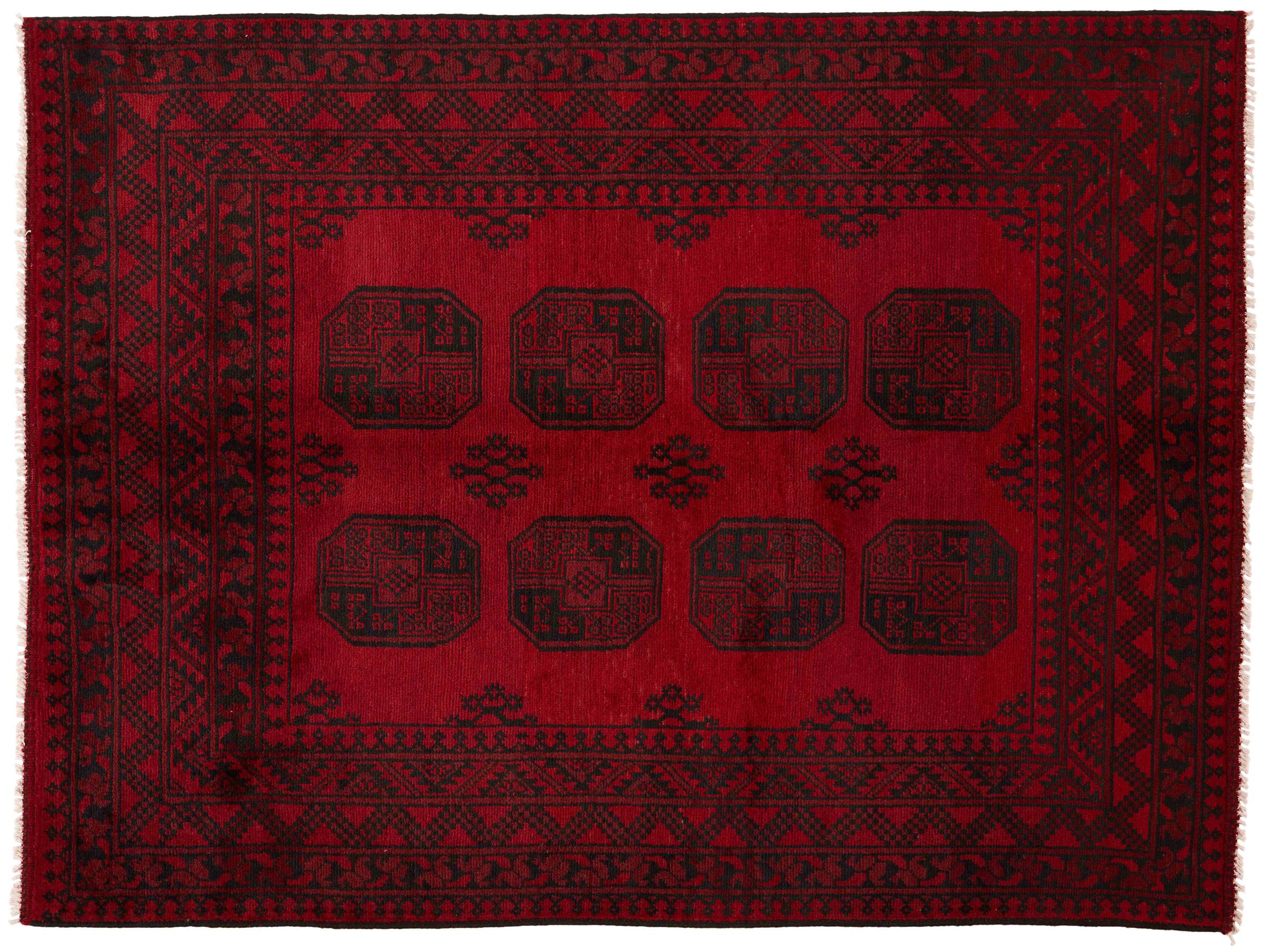
Aktscha rugs – Warm-toned classics of Turkmen tradition
Aktscha rugs are a living expression of Turkmen nomadic traditions, with every knot carrying the heritage of Central Asian rug culture. Their deep red ground and traditional gul motifs create a bold yet harmonious visual character. Each piece brings individuality and a sense of history into the home.
2-ply and 3-ply Pakistani rugs – Soft wool and harmonious oriental patterns
These rugs carry forward the refined legacy of Central Asian nomadic traditions, where the orderly simplicity of Tekke and Bokhara patterns meets Pakistani craftsmanship. Their warm colours and soft wool create a cosy, balanced atmosphere.