Blog
The text is an excerpt from Mónika Lackner’s study The “Torontál” Rug and Cottage-Industry Initiatives.
“Torontál”
The term Torontál rug may have originated in 1881 during correspondence and meetings between Sándor Rejtő, an industrial inspector examining ways to develop cottage industries, the National Committee for Industrial Education and Cottage Industries, and the Ministry of Agriculture, Industry and Trade. The term was certainly in use by the time of the national women’s industry exhibition held in the autumn of 1881. The name refers to Torontál County, which played an important role in promoting cottage-industry development.
In his book The Torontál Rug (The Torontál Rug. Twenty-Five Years of Rug Weaving in Banat from Antal Streitmann to Sarolta Kovalszky, Novi Sad, Forum, 1993), Ferenc Németh explored the many historically changing meanings of this expression, which is still widely used in Hungary today. Drawing on historical sources and the local press, he summarised the history of cottage-industry organisation connected both with applied arts and industrial production.
The term is known only in Hungary. This also shows that while the study of Serbian and Romanian rugs belongs primarily to Serbian and Romanian ethnography and museum research, Hungarian scholarship can contribute by examining the organisation of cottage industries associated with Torontál rugs.
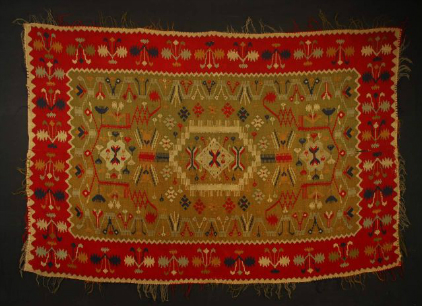 |
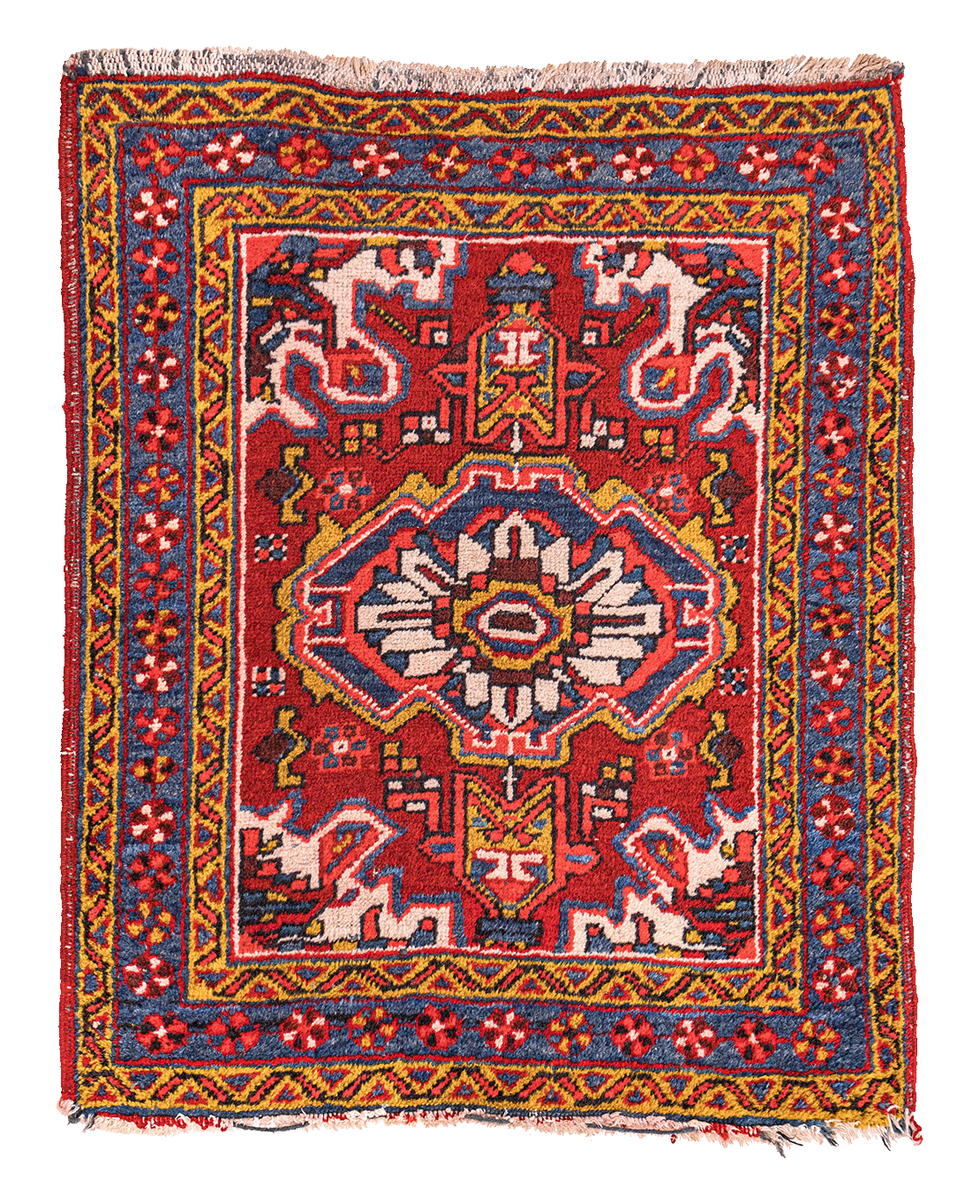
Rug made in a cottage-industry training workshop, Banat, 1890–1900. Museum of Ethnography; 73.6.3; photograph by Krisztina Sarnyai. |
Between 1885 and 1914, the Torontál rug was one of the best-known cottage-industry products. At the Millennium Exhibition of 1896, the cottage-industry hall featured the most important branches and regions of Hungarian cottage industry in staged scenes with mannequins. These included a straw-hat-making family from Hajdúnánás, a lace-making girl from Banská Bystrica, a basket-weaving family from Dorogma, toy makers from Bardejov and an embroidering woman from Kalotaszeg. Rug weaving was represented by a mannequin of a Torontál rug weaver.
The redesigned rugs, adapted to new functions and object types, were intended mainly for middle-class homes or commercial interiors, such as massage salons.
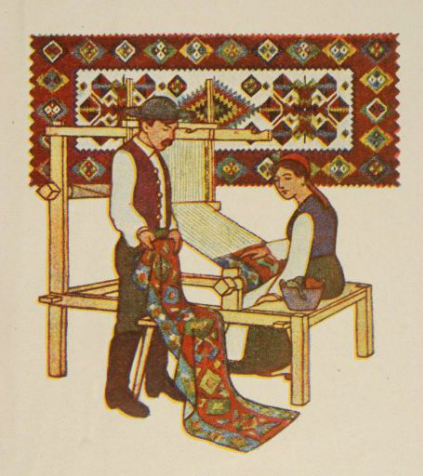 |
Letterhead of Vilmos Grünbaum’s company; Nagybecskerek, 1910; digital reproduction |
At the very end of the 19th century and the beginning of the 20th century, several companies produced Torontál rugs and employed cottage-industry workers. These included Nina Láng’s enterprise in Elemér, the business of Mrs Jakab Guttmann and her sons, and Vilmos Grünbaum’s cottage-industry company in Nagybecskerek.
Grünbaum’s company employed cottage-industry workers and sold “Torontál rugs of its own manufacture”. It also advertised itself as the warehouse of the “First Hungarian Torontál Rug and Upholstery Fabric Factory”. The company is particularly important in relation to the Museum of Ethnography, as several rugs in its textile collection were purchased from Grünbaum between 1910 and 1913. As the company’s letterhead shows, its main activity between 1900 and 1913 was the sale of cottage-industry products. The letterhead also featured a small image depicting rug weaving. Arnold and Frigyes Grünbaum, the owners of the Vilmos Grünbaum company, also exhibited at the Museum of Applied Arts’ Christmas exhibition in 1903.
Despite the popularity of Torontál rugs, there is also evidence of difficulties in selling them. In 1898, Irén T. Eszenszky, head of the cottage-industry centre in Nagykikinda, wrote that wealthy customers preferred Persian rugs and looked down on local kilims, while less affluent buyers could purchase cheaper rugs in shops.
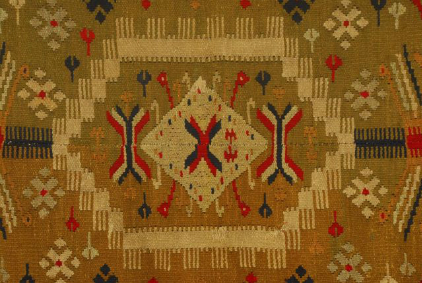
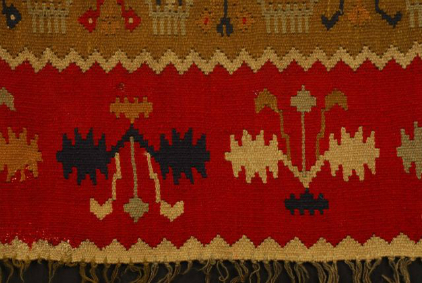
Rugs in the Museum of Ethnography
The Museum of Ethnography has a rich collection relating to this field. It also preserves objects gathered for the national cottage-industry programme of the 1873 Vienna World’s Fair. The most significant part of the textile collection was acquired in the early 20th century. In 1905, the museum purchased several rugs and woven shoulder bags from the estate of drawing teacher László Dömötör, unfortunately without any more precise information about their place of origin. The richest part of the collection came from Vilmos Grünbaum, a merchant from Nagybecskerek, who sold rugs and antique kilims to the museum on several occasions between 1909 and 1913.
Recent Serbian research has helped scholars interpret the objects in the collection. In particular, the parallels published by Mirjana Maluckov in her catalogue of the collection of the Museum of Ethnography in Novi Sad have helped identify the origins of the objects and estimate when they were made. During her research, Maluckov also examined several pieces from the Budapest collection and included them in her work.
Her research shows that the Museum of Ethnography holds examples of all the major Serbian rug types from Bačka and Banat, except for rugs decorated with naturalistic motifs. At the same time, very few rugs are known or preserved that were made as part of organised cottage-industry programmes or within cottage-industry institutions.